
ABOUT

Research

Our primary aim has always been to provide exceptional tropical marine wildlife holidays, but the ability to spend many weeks at sea every year also provides a platform to conduct marine research.
Cetacean Research

Much of my research over the past 30 years has concentrated on the cetaceans of the Maldives and the wider Indian Ocean. All cetacean sightings on our trips are recorded, and eventually analysed and published in the scientific literature. Studies of cetacean seasonality in the Maldives led directly to the discovery of the Blue Whale hotspot of southern Sri Lanka. Research on cetacean strandings in the Maldives led to the re-discovery of two species of Beaked Whales (see below). More recent publications include studies of diurnal behaviour in atoll-associated Spinner Dolphins and of population structure in central Indian Ocean Humpback Whales. For a summary of information on cetaceans in the Maldives:
Read Maldives Cetacean Review

Dragonfly Migration

During my early years living and working in Malé in the 1980s, I noticed sudden explosions of dragonfly numbers every year in October. Their annual appearance was well known to Maldivians, but was nevertheless unexplained. Dragonflies need freshwater to breed: they lay their eggs into freshwater and their larvae develop in freshwater. Yet the Maldive Islands are all low and sandy, with hardly any surface freshwater…
Watch on Youtube

Economics of Marine Tourism

Wildlife is often undervalued in traditional economics unless it is directly extracted for human use. Because policymakers tend to prioritize economic arguments over claims of intrinsic value, demonstrating the non-extractive economic benefits of wildlife can support conservation efforts.

Two studies on shark and manta ray tourism in the Maldives illustrate this. In 1992, a single Grey Reef Shark was estimated to generate about US$3,300 annually in tourist revenue but only US$32 as a one-time catch for fishermen. A later study found manta rays generated roughly US$8.1 million per year for the Maldivian economy (2006–08). Both studies helped inform government decisions to protect these species.
View Research

Rediscovering the
Longman's Beaked Whale

Beaked Whales are animals of the deep ocean, occurring far offshore and spending most of their lives foraging for squid at great depths, returning only briefly to the surface to breath. As a result they are the least-known cetaceans. And perhaps the least-known of them all were Longman’s Beaked Whale (previously known from just two skulls) and Deraniyagala’s Beaked Whale (described from a single stranded specimen, long since forgotten). Recognizing stranded specimens of both species in the Maldives allowed me to contribute to the rediscovery of these two extraordinary creatures.
Read Paper

National Bird List

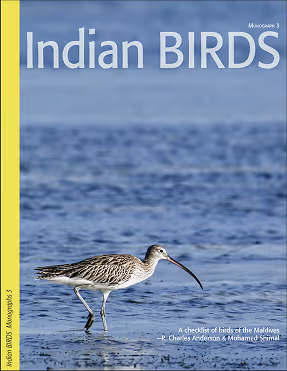
The Maldives is not renowned for its diversity or abundance of birds. Nevertheless, there is much of interest. Some species do occur seasonally in large numbers, there are a handful of endemic varieties, and a total of just over 200 species has been recorded. Seabirds are plentiful and seasonally abundant, with regular visitors from elsewhere in the tropical and subtropical Indian Ocean, from the western Pacific and from the Southern Ocean. For terrestrial birds, Maldives lies at the southern end of the great Central Asian Flyway, and every year the islands receive numerous northern birds that have flown southwards into South Asia to avoid the northern winter. I have been recording birds in the Maldives for decades, and with Maldivian colleague Mohamed Shimal recently compiled the most up-to-date national checklist:
View Bird List

Guidebook

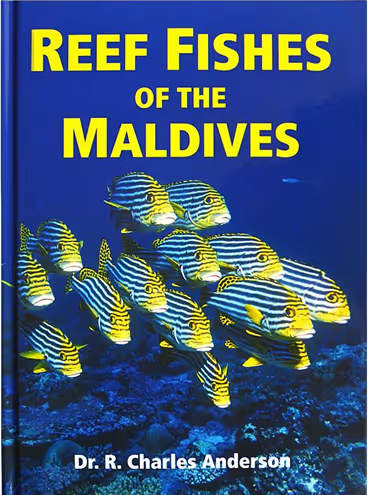
With colleagues at the Maldives Marine Research Institute, Charles has been maintaining the national checklist of fishes for many years. Over 1200 species have been documented, each catalogued with museum specimens and photographic records. This provides a solid scientific background for other works, including Charles’ best-selling field guide ‘Reef Fishes of the Maldives’, which cover some 500 of the species most likely to be seen while diving or snorkelling, all illustrated with underwater photos taken in the Maldives
Buy Book